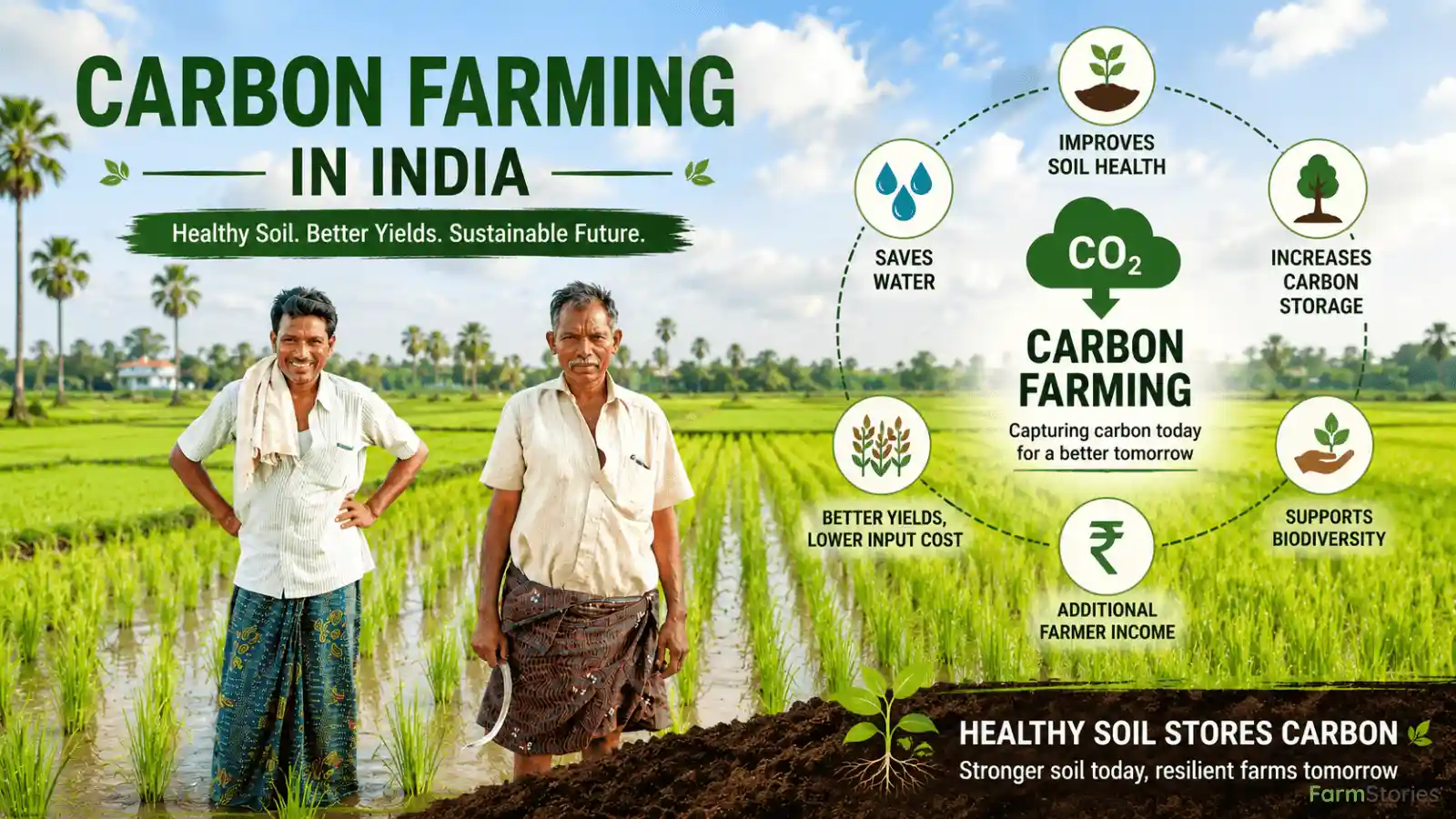
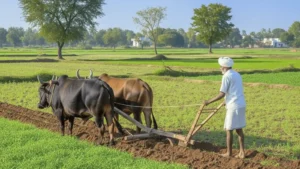
Climate change is no longer a distant concern for Indian agriculture. Rising temperatures, irregular rainfall, declining groundwater levels, and soil degradation are already affecting crop productivity in many parts of the country. Farmers are looking for practical ways to improve soil health, reduce production costs, and make their farms more resilient without compromising yields.
Against this backdrop, carbon farming in India is emerging as an important opportunity. It combines sustainable farming practices with the possibility of earning additional income through carbon credits. Instead of treating agriculture only as a source of greenhouse gas emissions, carbon farming recognizes that healthy agricultural land can also remove and store carbon from the atmosphere.
This transition received fresh attention when Chhattisgarh launched its first organized carbon farming initiative in the Dhamtari district. The project covers around 80,000 hectares, including 30,000 hectares of paddy fields where farmers will adopt Alternate Wetting and Drying (AWD) irrigation practices to reduce methane emissions. Supported by climate technology organization PRITHU, the initiative includes an investment of ₹5 crore over three years for capacity building, farmer training, and rural skill development. The project also aims to create additional income opportunities for participating farmers through verified carbon credits, although the actual returns will depend on successful implementation, verification, and carbon market prices.
The Chhattisgarh initiative is part of a broader movement toward climate-smart agriculture. Governments, research institutions, agribusiness companies, and international organizations are increasingly promoting farming practices that improve soil health while reducing greenhouse gas emissions. Global food companies are also paying greater attention to sustainability, creating new opportunities for farmers who can demonstrate environmentally responsible production.
For Indian farmers, however, many questions remain.
What exactly is carbon farming? How are carbon credits generated? Can small farmers participate? How much additional income is possible? Which crops are suitable? And what challenges should farmers understand before joining a carbon project?
This comprehensive FarmStories guide answers these questions in simple language. Whether you grow paddy, wheat, sugarcane, vegetables, plantation crops, or manage an orchard, understanding carbon farming can help you prepare for an agricultural sector that increasingly values both productivity and environmental sustainability.
Table of Contents
What Is Carbon Farming?
Carbon farming is a farming approach that uses agricultural practices to increase the amount of carbon stored in soil and vegetation while reducing greenhouse gas emissions from farming activities.
Join a community dedicated to sustainable cultivation. Subscribe to FarmStories below for free, authentic insights into modern agri-tech and organic farming methods.
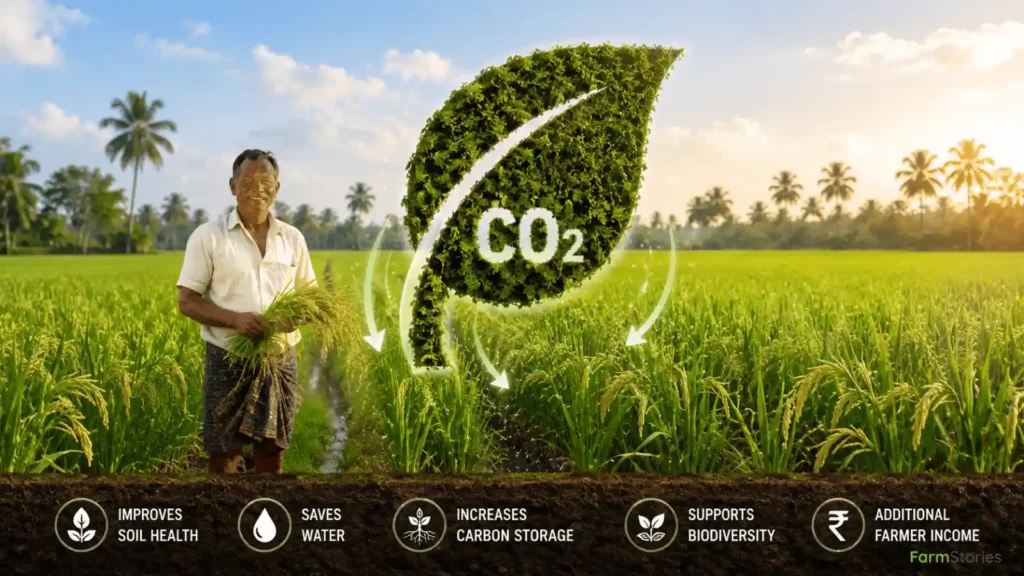
Plants naturally absorb carbon dioxide from the atmosphere during photosynthesis. A portion of this carbon is transferred into the soil through roots, crop residues, fallen leaves, and organic matter. Healthy soils can store large amounts of this carbon for many years when they are managed properly.
Traditional farming methods such as excessive tillage, continuous flooding in paddy fields, and burning crop residues can release stored carbon back into the atmosphere. Carbon farming encourages alternative practices that keep more carbon in the soil while maintaining productive farmland.
In simple terms, carbon farming focuses on improving the health of agricultural land so that it works as both a productive farm and a natural carbon sink.
Unlike conventional farming, carbon farming does not require farmers to stop producing food. Instead, it encourages better soil management, efficient water use, diversified cropping systems, and reduced emissions. Many of these practices also improve soil fertility, water retention, and long-term farm productivity.
Did You Know?
Healthy soil rich in organic matter can hold significantly more water than degraded soil. This helps crops tolerate dry spells better and reduces the need for frequent irrigation.
India’s agriculture sector supports millions of farming families and contributes significantly to food security. At the same time, agriculture is both affected by climate change and contributes to greenhouse gas emissions through activities such as methane emissions from rice cultivation, livestock production, fertilizer use, and crop residue burning.
Several factors are driving interest in carbon farming across India.
Soil Degradation
Many agricultural regions have experienced declining soil organic matter because of intensive cultivation, limited organic input application, and repeated tillage. Lower soil organic carbon reduces the soil’s ability to retain moisture and nutrients, making crops more vulnerable to drought and heat stress.
Water Scarcity
Groundwater levels continue to decline in several states. Practices such as Alternate Wetting and Drying in paddy cultivation can reduce irrigation water use while lowering methane emissions, making water management more sustainable.
Climate Change
Farmers increasingly face delayed monsoons, unexpected heavy rainfall, prolonged dry spells, and heat waves. Improving soil structure through regenerative practices can help farms become more resilient to these changing conditions.
Growing Demand for Sustainable Food
Food companies, exporters, and consumers are paying greater attention to sustainability. Some businesses are beginning to work with farmers who can demonstrate environmentally responsible production methods, creating additional opportunities beyond traditional crop sales.
National Climate Goals
India has committed to reducing the emissions intensity of its economy while increasing carbon sinks through forests and improved land management. Although agriculture remains essential for food production, improving farming practices can contribute to these broader environmental goals without reducing productivity.
Expert Insight
According to the Food and Agriculture Organization (FAO), increasing soil organic carbon improves soil fertility, enhances water retention, supports biodiversity, and contributes to climate change mitigation. Many regenerative farming practices deliver both environmental and agricultural benefits when adapted to local farming conditions.
How Carbon Farming Works
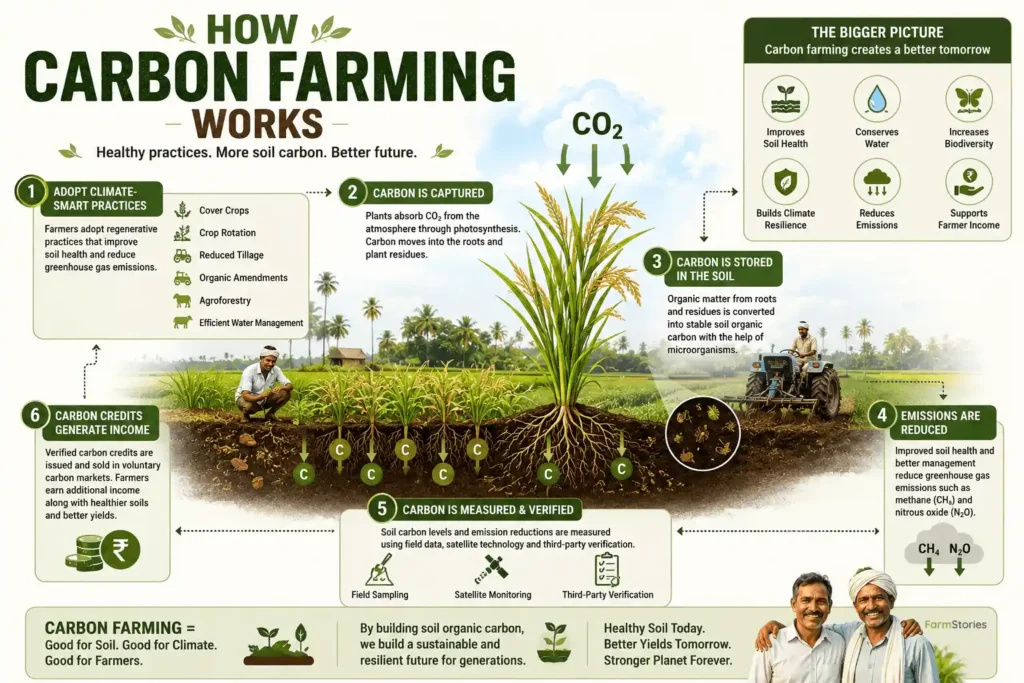
Carbon farming follows a structured process rather than a single farming practice. Farmers adopt approved land management practices, the environmental benefits are measured and verified, and eligible emission reductions or carbon storage may be converted into carbon credits.
The typical process includes the following steps:
Farmers adopt approved regenerative farming practices such as reduced tillage, cover cropping, agroforestry, or Alternate Wetting and Drying in paddy cultivation.
These practices gradually improve soil organic carbon or reduce greenhouse gas emissions from farming activities.
Soil samples, satellite imagery, field inspections, and farm records establish a baseline and monitor changes over time.
Independent third-party organizations verify the results using internationally accepted standards.
Verified emission reductions or additional carbon storage are converted into carbon credits.
Project developers sell these credits in voluntary carbon markets to companies seeking to offset part of their greenhouse gas emissions.
Revenue is shared with participating farmers according to the terms of the project agreement.
It is important to understand that this process usually takes time. Carbon credits are not generated immediately after changing farming practices. Verification may take several seasons, and payments depend on successful project validation and prevailing carbon market prices.
What Are Carbon Credits?
A carbon credit is a certified unit representing the reduction, avoidance, or removal of one metric tonne of carbon dioxide equivalent (CO₂e).
Carbon credits can be generated through different activities, including forest conservation, renewable energy, methane reduction, and agricultural carbon farming.
For farmers, credits are generally created in two ways:
Increasing the amount of carbon stored in agricultural soils through regenerative farming practices.
Reducing greenhouse gas emissions, such as methane emissions from rice cultivation through improved water management.
Companies purchase these credits to help meet their sustainability goals or voluntary climate commitments. However, carbon credits only have value after they have been independently verified and certified under recognized standards.
Because the certification process is complex and expensive, individual smallholders usually participate through Farmer Producer Organizations (FPOs), cooperatives, or specialized carbon project developers rather than selling credits independently.
How Farmers Can Earn Money Through Carbon Credits
Carbon farming creates the possibility of earning additional income, but it should not be viewed as a guaranteed or immediate source of revenue.
Most Indian farms are relatively small, making it impractical for individual farmers to complete the technical processes required for international carbon certification. Instead, projects usually follow an aggregation model where many farmers join together under a single registered carbon project.
Participating farmers agree to follow approved farming practices, maintain records of farm activities, and allow periodic monitoring and verification. After successful verification, the project developer sells the carbon credits and distributes revenue according to the project’s agreement.
The amount earned varies widely and depends on several factors, including:
Farm size
Crop type
Soil conditions
Farming practices adopted
Amount of verified carbon stored or emissions reduced
Carbon market prices
Revenue-sharing agreement with the project developer
For this reason, farmers should carefully review contracts before joining any carbon project and understand how payments, responsibilities, monitoring, and long-term commitments will be managed.
Carbon Farming in India: An Infographic
Core Carbon Farming Practices That Improve Soil Health and Reduce Emissions
Carbon farming is not based on a single technique. It combines several farming practices that improve soil health, increase carbon storage, and reduce greenhouse gas emissions. Farmers can adopt one or more of these practices depending on their crops, climate, water availability, and farming system.
Many of these methods are already familiar to Indian farmers. The difference is that carbon farming encourages their consistent use while measuring their environmental benefits through scientific monitoring and verification.
1. Cover Crops
Cover crops are plants grown primarily to protect and improve the soil rather than for harvest. Instead of leaving fields bare after harvesting the main crop, farmers sow cover crops that continue growing until the next cropping season.
Common cover crops in India include:
Sunn hemp
Cowpea
Green gram
Black gram
Mustard
Dhaincha
How Cover Crops Help
Living roots feed beneficial soil microorganisms throughout the year. As these crops grow, they absorb carbon dioxide from the atmosphere and transfer part of that carbon into the soil through their roots and plant residues.
Cover crops also:
Reduce soil erosion during heavy rains.
Improve soil structure.
Suppress weed growth.
Increase soil organic matter.
Improve moisture retention.
Leguminous cover crops provide an additional benefit by fixing atmospheric nitrogen, reducing the need for synthetic fertilizers in the following crop.
Practical Example
Many farmers in rice-growing regions sow green gram after harvesting paddy. Besides providing an additional harvest, the crop improves soil fertility before the next season.
2. Crop Rotation
Growing the same crop repeatedly removes similar nutrients from the soil and increases pest and disease pressure. Crop rotation breaks this cycle by alternating crops with different nutrient requirements and root systems.
Instead of cultivating rice after rice or wheat after wheat, farmers can rotate with crops such as:
Pulses
Oilseeds
Millets
Vegetables
Fodder crops
Benefits of Crop Rotation
A well-planned rotation can:
Improve soil fertility.
Reduce pest infestations.
Lower fertilizer requirements.
Increase biodiversity.
Improve soil carbon storage.
For example, rotating paddy with pulses can naturally improve nitrogen availability while supporting healthier soil biology.
3. Reduced Tillage or Zero Tillage
Traditional farming often involves repeated ploughing before every crop. While tillage prepares the seedbed, excessive soil disturbance exposes stored organic matter to oxygen, accelerating carbon loss.
Reduced tillage minimizes soil disturbance, while zero tillage places seeds directly into the previous crop residues using specialized equipment.
Benefits
Reduced tillage can:
Preserve soil organic carbon.
Reduce fuel consumption.
Lower labour costs.
Improve soil moisture.
Reduce erosion.
Zero tillage has already been adopted in several wheat-growing areas of Punjab, Haryana, and Uttar Pradesh, particularly after rice harvest.
Things Farmers Should Know
Reduced tillage may initially require better weed management and suitable machinery. Over time, many farmers report improved soil structure and lower cultivation costs.
4. Agroforestry
Agroforestry combines trees with crops or livestock on the same land.
Unlike conventional farming, where fields remain completely open, agroforestry introduces long-term vegetation that stores significant amounts of carbon while providing additional income.
Popular agroforestry species include:
Melia dubia
Casuarina
Poplar
Eucalyptus (where appropriate)
Bamboo
Fruit trees
Coconut
Arecanut
Benefits
Agroforestry can:
Increase carbon storage.
Protect fields from wind erosion.
Improve biodiversity.
Provide timber, fruits, fodder, or fuelwood.
Improve long-term farm income.
Boundary plantations are one of the simplest ways for farmers to begin integrating agroforestry without reducing crop area significantly.
5. Organic Manure, Compost, and Biochar
Healthy soil contains abundant organic matter. Returning organic materials to the field helps rebuild this natural fertility.
Common organic amendments include:
Farmyard manure
Vermicompost
Compost
Crop residue compost
Green manure
Biochar
Farmyard Manure and Compost
Well-decomposed manure improves:
Soil structure.
Water-holding capacity.
Microbial activity.
Nutrient availability.
Unlike fresh manure, properly composted material decomposes more efficiently and contributes to stable soil organic matter.
Biochar
Biochar is produced by heating agricultural biomass under low-oxygen conditions.
Because biochar decomposes very slowly, it can remain in the soil for many years while improving water retention and nutrient availability.
Although biochar is gaining attention in carbon farming projects, its adoption in India is still limited and depends on local availability and production systems.
One of the biggest advantages of carbon farming is that many recommended practices already improve farm productivity. Better soil structure, improved water retention, and increased microbial activity often support healthier crops even before carbon credit payments become available.
Chhattisgarh has become one of the latest states to introduce a structured carbon farming programme, marking an important step toward climate-smart agriculture in India.
The initiative is being implemented in Dhamtari district, an important rice-growing region often referred to as part of the state’s “Rice Bowl.”
The programme focuses on two major interventions.
The first aims to improve Soil Organic Carbon (SOC) across approximately 80,000 hectares of agricultural land. Farmers will be encouraged to adopt practices that increase organic matter, improve soil fertility, and enhance the land’s ability to store carbon.
The second focuses on Alternate Wetting and Drying (AWD) across around 30,000 hectares of paddy fields. Since continuously flooded rice fields produce methane, improved water management can significantly reduce emissions while also conserving irrigation water.
The initiative is supported by climate technology organisationPRITHU, which plans to invest ₹5 crore over three years in farmer training, capacity building, knowledge exchange, and rural skill development.
According to project estimates, participating farmers could collectively receive up to ₹250 crore over the project’s lifetime through verified carbon credit generation. However, these figures represent projected outcomes rather than guaranteed payments. Actual returns will depend on successful implementation, third-party verification, carbon market prices, and farmer participation.
Beyond carbon credits, the initiative aims to improve long-term soil health, reduce input costs, strengthen climate resilience, and create employment opportunities linked to sustainable agriculture.
If successful, the Dhamtari model could provide a framework for similar projects in other agricultural regions across India.
Carbon Farming Initiatives Across Indian States
Carbon farming is still developing in India, but several states have already introduced climate-smart agriculture programmes that support similar objectives.
Healthy soils absorb and retain more water, reducing irrigation requirements during dry periods.
Lower Input Costs
Practices such as crop rotation, compost use, and precision nutrient management can reduce dependence on chemical fertilizers over time.
Climate Resilience
Healthy soils help crops tolerate drought, heavy rainfall, and temperature fluctuations more effectively.
Additional Income Opportunities
Verified carbon credits may provide supplementary income alongside traditional crop production.
Improved Market Opportunities
As sustainability becomes increasingly important in food supply chains, environmentally responsible farming practices may create additional business opportunities for producers.
Challenges Farmers Should Know Before Joining a Carbon Farming Project
Carbon farming offers promising opportunities, but it is not a quick or guaranteed way to earn additional income. Farmers should understand the practical challenges before enrolling in any project.
1. Carbon Credits Take Time
Unlike selling crops after harvest, carbon credits are generated only after farming practices have been monitored and verified over time.
Most projects require at least two to three years before the first batch of carbon credits is issued. Farmers should therefore treat carbon farming as a long-term investment in soil health rather than an immediate source of income.
2. Small Landholdings
Most Indian farmers own relatively small landholdings.
Because measuring soil carbon, conducting field surveys, and completing third-party verification are expensive, individual farmers usually cannot participate independently.
Joining through an FPO, cooperative, or registered project developer is often the most practical option.
3. Market Prices Can Change
Carbon credits are traded in voluntary carbon markets.
Their value depends on several factors, including:
Global demand
Credit quality
Certification standards
Market conditions
As a result, payments can vary from one project to another and from year to year.
4. Continuous Monitoring Is Required
Farmers participating in carbon projects are generally expected to:
Maintain records of farming activities.
Allow field inspections.
Follow agreed farming practices.
Cooperate during verification visits.
Failure to comply with project requirements may affect eligibility for carbon credit payments.
5. Read the Agreement Carefully
Before signing any agreement, farmers should understand:
Revenue-sharing arrangements
Project duration
Responsibilities of each party
Monitoring requirements
Exit conditions
Payment timelines
If anything is unclear, seek advice from the local agriculture department, FPO, or an agricultural extension officer.
Step-by-Step Guide to Getting Started with Carbon Farming
If carbon farming projects become available in your area, the following steps can help you prepare.
Step 1: Assess Your Farm
Start by understanding your farm’s current condition.
Check:
Soil Health Card
Irrigation system
Crop rotation practices
Residue management
Organic matter use
Knowing your baseline helps identify areas for improvement.
Step 2: Contact Your Local FPO or Agriculture Department
Most farmers will participate through organized projects rather than individually.
Ask whether any carbon farming or regenerative agriculture projects are operating in your district.
Step 3: Adopt Recommended Practices
Depending on your farm, this may include:
Reduced tillage
Crop rotation
Cover crops
Compost application
Agroforestry
Alternate Wetting and Drying in paddy
Precision nutrient management
Not every practice suits every farm. Choose methods appropriate for your crops, climate, and available resources.
Step 4: Maintain Farm Records
Simple records can make verification easier.
Keep information on:
Sowing dates
Irrigation schedules
Fertilizer application
Organic manure use
Crop residue management
Harvest dates
Many projects also use satellite imagery and periodic field visits alongside farmer records.
Step 5: Complete Verification
Independent auditors evaluate whether the agreed farming practices have been followed and whether measurable environmental benefits have been achieved.
Only verified projects can generate carbon credits.
Step 6: Receive Carbon Credit Payments
Once carbon credits are sold, participating farmers receive payments according to the terms of the project agreement.
The amount depends on verified results and prevailing market prices.
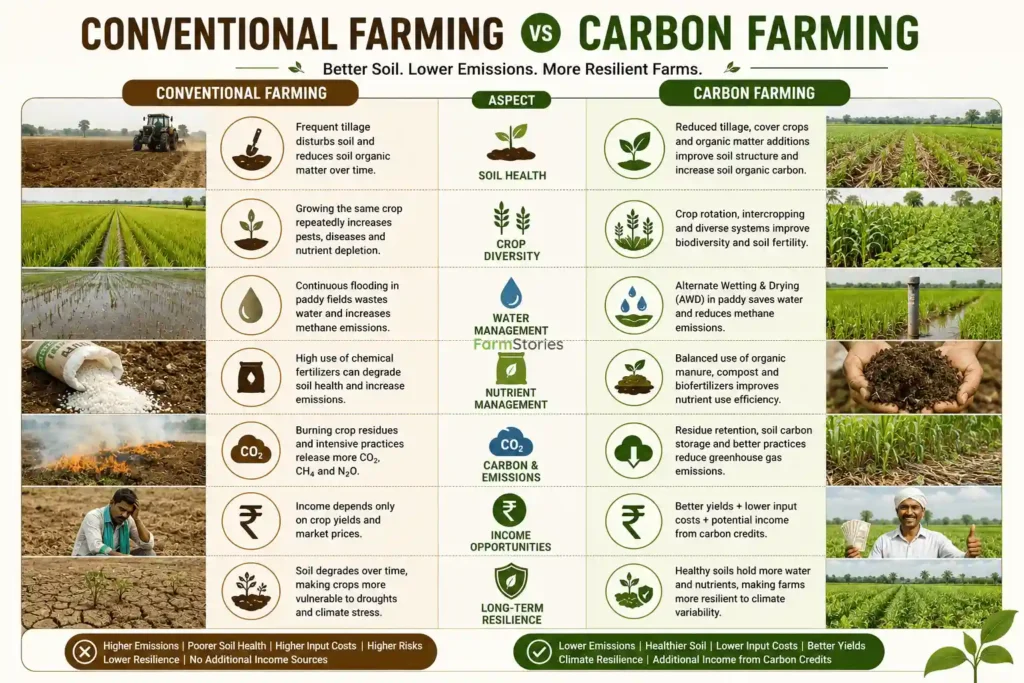
Carbon Farming vs Conventional Farming
Farming Practice
Conventional Farming
Carbon Farming
Soil Management
Frequent tillage
Reduced or minimum tillage where suitable
Crop Residue
Often burned or removed
Retained, mulched, or composted
Water Management
Continuous flooding in many paddy fields
Alternate Wetting and Drying or other water-efficient methods where appropriate
Fertilizer Use
Primarily synthetic fertilizers
Balanced use of organic and inorganic nutrients
Income Source
Crop production
Crop production plus potential carbon credit income
Soil Organic Matter
Often declines over time
Managed to improve over time
Climate Impact
Higher greenhouse gas emissions in some systems
Lower emissions and increased carbon storage
Carbon Farming in India – A comparison chart
Myth vs Fact
Myth
Fact
Carbon farming means stopping food production.
Farmers continue producing crops while adopting improved management practices.
Carbon credits provide guaranteed income.
Payments depend on successful verification and market prices.
Only large farmers can participate.
Small farmers may participate through FPOs, cooperatives, or aggregated projects.
Organic farming is mandatory.
Carbon farming includes many practices. Organic farming is only one possible approach.
Carbon farming is only for rice farmers.
Paddy, wheat, sugarcane, plantation crops, orchards, and other farming systems may also be eligible depending on the project methodology.
Expert Insight
Healthy soil does much more than store carbon.
Research by ICAR, the IPCC, and other agricultural organizations shows that increasing soil organic matter improves water retention, nutrient availability, soil biodiversity, and long-term agricultural productivity. These benefits often help farmers improve soil health and crop resilience even before any carbon credit income is generated.
Did You Know?
Many farmers already practice elements of carbon farming without realizing it. Crop rotation, compost application, agroforestry, and reduced residue burning have long been part of sustainable farming in many parts of India.
Government Support for Climate-Smart Agriculture
India has introduced several programmes that support sustainable farming practices closely linked with carbon farming.
National Mission for Sustainable Agriculture (NMSA)
NMSA promotes:
Efficient water management
Soil health improvement
Climate-resilient farming
Resource conservation technologies
National Innovations in Climate Resilient Agriculture (NICRA)
Implemented by ICAR, NICRA develops and demonstrates technologies that help farmers adapt to climate change while maintaining productivity.
PKVY encourages organic farming through cluster-based approaches by supporting:
Organic inputs
Farmer training
Certification
Sustainable production practices
Soil Health Card Scheme
The Soil Health Card Scheme provides information on:
Soil nutrient status
Organic carbon levels
Fertilizer recommendations
Understanding soil health is an important first step for farmers interested in carbon farming.
The Future of Carbon Farming in India
Carbon farming is still at an early stage in India, but interest is growing steadily.
Several factors are likely to support its expansion in the coming years.
Growing corporate sustainability commitments are increasing demand for verified carbon credits.
Advances in satellite monitoring, remote sensing, and digital data collection are making it easier to monitor agricultural projects.
Research institutions continue to improve methods for measuring soil carbon more accurately.
State governments are also exploring climate-smart farming models that combine environmental benefits with improved farmer livelihoods.
However, widespread adoption will depend on transparent project management, farmer awareness, reliable verification systems, and fair revenue-sharing arrangements.
If these challenges are addressed, carbon farming could become an important component of sustainable agriculture in India.
Frequently Asked Questions
1. What is carbon farming?
Carbon farming refers to agricultural practices that increase carbon storage in soil or reduce greenhouse gas emissions while improving soil health and farm sustainability.
2. Can Indian farmers earn money through carbon credits?
Yes. Farmers may earn additional income by participating in verified carbon farming projects, usually through FPOs, cooperatives, or project developers.
3. Is carbon farming suitable for small farmers?
Yes. Small farmers generally participate through aggregation models rather than individually.
4. Which crops are suitable for carbon farming?
Rice, wheat, sugarcane, cotton, maize, plantation crops, orchards, and several other cropping systems may qualify depending on the project’s methodology.
5. How long does it take to receive carbon credit payments?
Many projects require two to three years before the first verified carbon credits are issued.
6. Do farmers need to stop using chemical fertilizers?
No. Carbon farming encourages balanced nutrient management rather than eliminating fertilizers completely.
7. Is organic farming compulsory?
No. Organic farming is only one of several practices that may contribute to carbon farming.
8. What is Soil Organic Carbon (SOC)?
Soil Organic Carbon is the carbon stored in soil organic matter. Higher SOC generally improves soil fertility, water retention, and biological activity.
9. What is Alternate Wetting and Drying (AWD)?
AWD is a water management technique for paddy cultivation where fields are allowed to dry to a recommended level before re-irrigation, helping reduce methane emissions and save water.
10. Who buys carbon credits?
Carbon credits are typically purchased by companies seeking to meet voluntary sustainability commitments or other climate-related objectives.
11. Can tenant farmers participate?
Eligibility depends on the project requirements and the legal rights to manage the land. Some projects may require the landowner’s consent.
12. Are carbon credit payments guaranteed?
No. Payments depend on successful verification, project performance, and carbon market prices.
13. What documents may be required?
Requirements vary by project but often include land records, identification documents, bank account details, and participation agreements.
14. Does carbon farming improve crop yields?
Improved soil health can support better productivity over time, but results vary depending on soil type, climate, crops, and management practices.
15. Where can farmers learn more?
Farmers can contact their local agriculture department, Krishi Vigyan Kendra (KVK), Farmer Producer Organization (FPO), or agricultural university for guidance on sustainable farming practices and any carbon farming initiatives available in their area.
Carbon farming represents a new direction for Indian agriculture, where improving soil health and reducing greenhouse gas emissions can also create opportunities for additional farm income.
The launch of Chhattisgarh’s carbon farming initiative reflects growing interest in climate-smart agriculture, but the broader value of carbon farming extends beyond carbon credits. Practices such as crop rotation, reduced tillage, compost application, agroforestry, and improved water management can strengthen soil health, improve water-use efficiency, and build resilience against climate-related risks.
Farmers should approach carbon farming with realistic expectations. Carbon credits are not guaranteed or immediate, and participation requires long-term commitment, proper documentation, and independent verification. Even so, many of the recommended practices provide agronomic benefits regardless of whether carbon credits are generated.
As more pilot projects emerge and scientific monitoring becomes more accessible, carbon farming is likely to play a larger role in India’s journey toward sustainable and climate-resilient agriculture.
Want to see these techniques in action? Join our growing community of urban farmers by following FarmStories on LinkedIn, Instagram, YouTube, and Facebook for daily tips, video guides, and harvest inspiration!