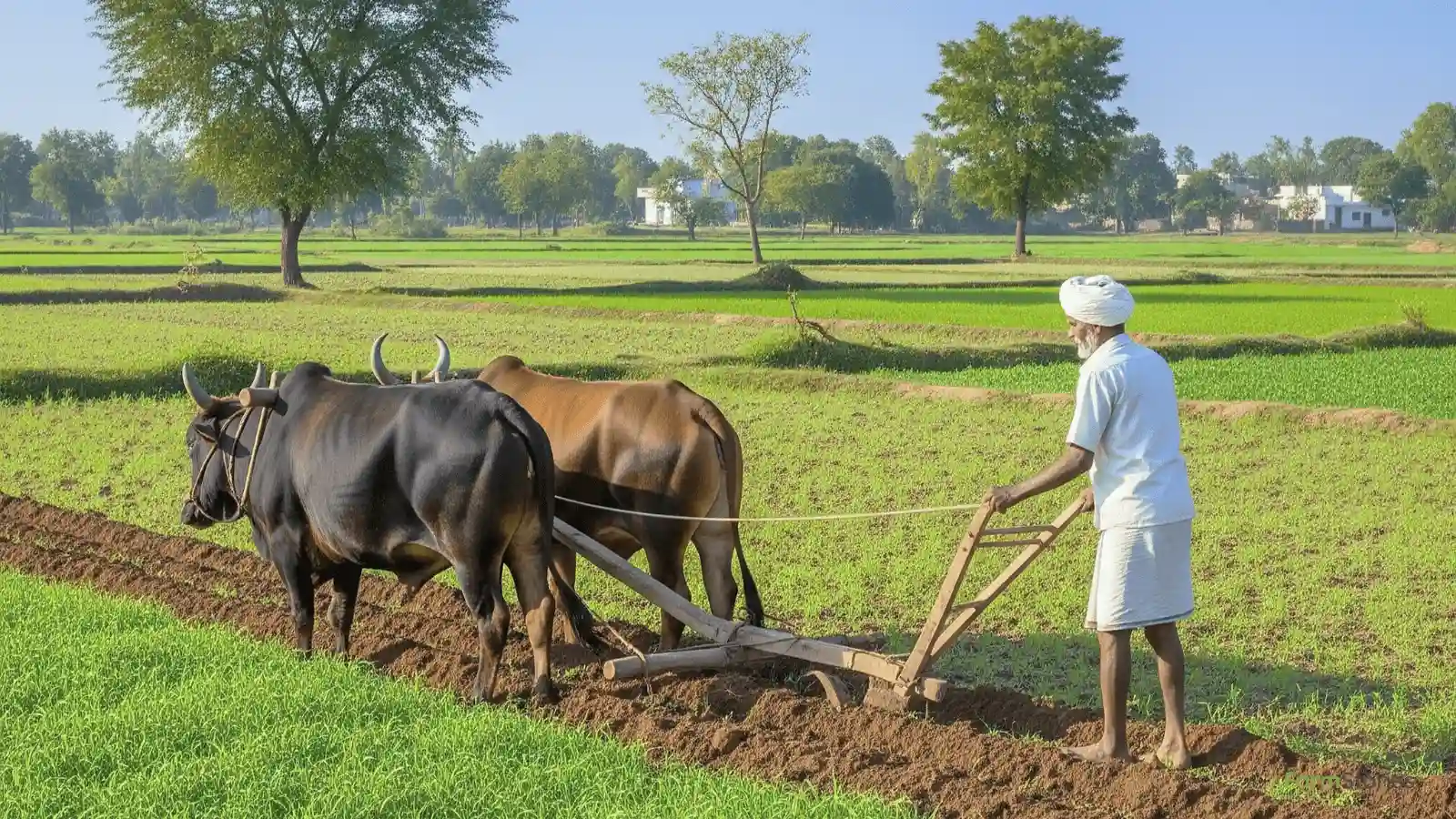
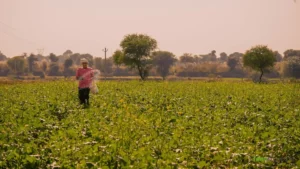
El Niño Farming in India is becoming increasingly important as weather patterns grow more unpredictable. Delayed monsoons, long dry spells, rising temperatures, and falling groundwater levels are forcing farmers to rethink traditional cultivation methods. While El Niño increases the risk of crop losses, it also encourages a shift toward farming practices that use less water, improve soil health, and reduce production costs.
For many Indian farmers, an El Niño year brings uncertainty. Rainfall becomes erratic, reservoirs receive less inflow, and irrigation expenses often increase. Crops that depend heavily on regular rainfall become more vulnerable, leaving farmers with higher input costs and lower yields.
Yet every difficult farming season also offers an opportunity to improve the way the farm is managed.
Across India, progressive farmers are proving that resilience does not always require expensive machinery or large investments. Many are reducing costs by making better use of crop residues, livestock manure, rainwater, and unused spaces around their fields. Small changes in farm management are helping them protect their crops while creating additional sources of income.
El Niño itself is not good for agriculture. It raises the risk of drought, heat stress, and moisture shortages. The real opportunity comes from adopting climate-smart practices that remain valuable long after the weather returns to normal.
This guide explains practical, affordable techniques that help farmers conserve water, improve soil fertility, lower production costs, and build a more sustainable farming system.
Table of Contents
El Niño Farming in India: Saving Water, Reducing Costs and Increasing Income
Climate uncertainty is becoming part of modern agriculture. Farmers who continue relying only on traditional methods may find it increasingly difficult to manage unpredictable rainfall and rising production costs.
El Niño Farming in India focuses on practical solutions rather than expensive technology. Many of the most effective practices use resources that are already available on the farm, including crop residues, livestock manure, green manure crops, and unused field boundaries.
Join a community dedicated to sustainable cultivation. Subscribe to FarmStories below for free, authentic insights into modern agri-tech and organic farming methods.
Instead of investing heavily in new equipment, farmers can improve soil moisture, reduce fertilizer expenses, recycle farm waste, and diversify income using proven techniques that have been promoted by agricultural universities, Krishi Vigyan Kendras (KVKs), and progressive farmers across the country.
Understanding El Niño and Its Impact on Indian Agriculture
El Niño is a natural climate phenomenon caused by warmer-than-normal sea surface temperatures in the central and eastern Pacific Ocean. Although it develops far from India, it influences weather patterns across South Asia and often affects the southwest monsoon.
Not every El Niño leads to drought, and its impact varies depending on several climatic factors. However, many El Niño years have been associated with weaker monsoons, below-average rainfall, and higher temperatures across several parts of India.
For farmers, these changes create multiple challenges.
Delayed monsoon onset
Long dry spells between rainfall events
Faster evaporation of soil moisture
Increased irrigation demand
Higher pest pressure
Reduced groundwater recharge
Greater uncertainty in crop planning
Small and marginal farmers are usually the most affected because they depend heavily on rainfall and have limited irrigation facilities.
Despite these risks, El Niño also encourages farmers to adopt practices that improve efficiency. Better water management, healthier soils, and diversified farming systems often continue delivering benefits even during years with normal rainfall.
Farmers should regularly monitor seasonal weather forecasts issued by the Indian Meteorological Department (IMD) to plan sowing, irrigation, and crop management decisions during an El Niño year.
Why Climate-Smart Farming Makes Sense During El Niño
Traditional farming systems were developed around relatively predictable monsoon patterns. Today, rainfall distribution has become less reliable, making efficient resource management more important than ever.
Climate-smart farming focuses on producing more with fewer resources while reducing the impact of weather-related risks.
Instead of depending entirely on chemical fertilizers, heavy irrigation, and a single crop, climate-smart farms improve soil organic matter, conserve moisture, recycle nutrients, and diversify income.
These changes do more than protect crops during dry years. They often reduce production costs every season.
A farmer who improves soil organic matter through compost and green manure usually needs fewer chemical fertilizers. A farmer who mulches the soil spends less on irrigation and weed control. Someone who keeps poultry or bees creates an additional income source without expanding farmland.
These practical improvements make farming more resilient regardless of whether rainfall is above or below normal.
The Indian Council of Agricultural Research (ICAR)recommends several climate-resilient farming practices, including soil moisture conservation, crop diversification, and integrated farming systems for managing weather-related risks.
Healthy soil stores more water, supports beneficial microorganisms, and supplies nutrients over a longer period. During an El Niño year, these qualities become especially valuable.
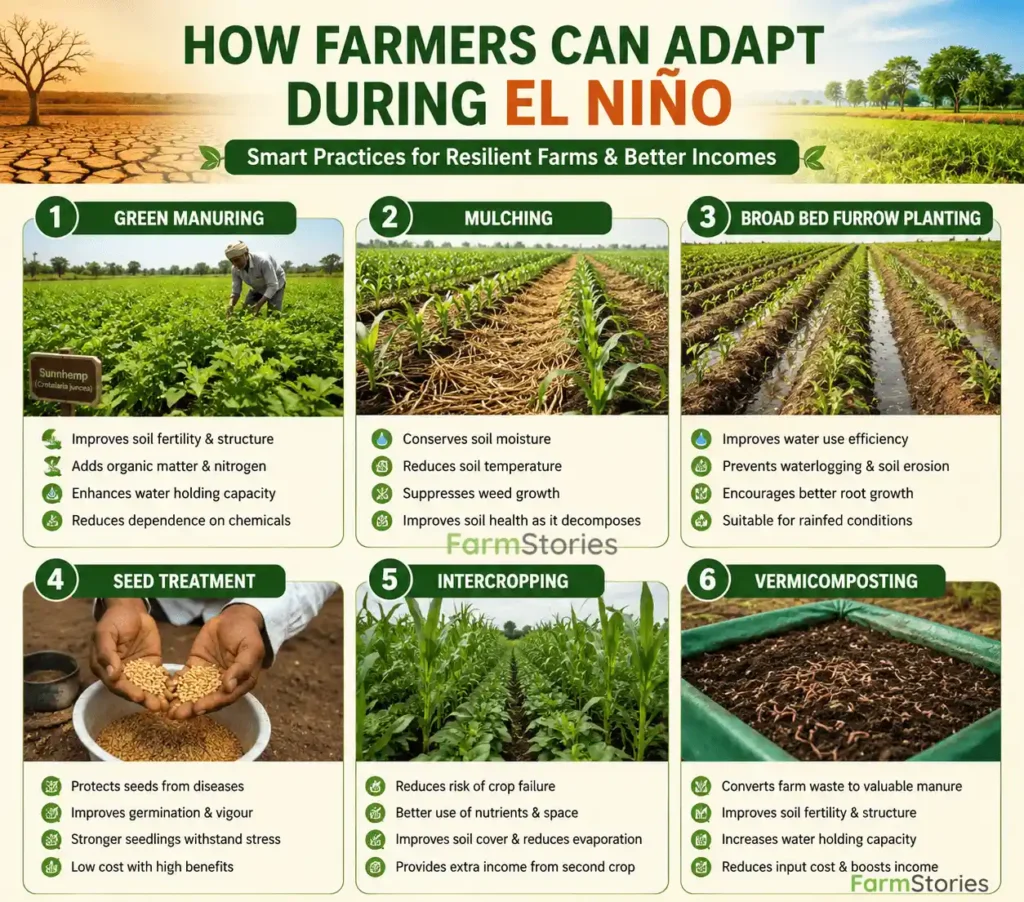
One of the simplest ways to improve soil naturally is through green manuring.
Instead of leaving land bare before planting the main crop, farmers can grow fast-growing crops such as sunnhemp (Crotalaria juncea) or dhaincha (Sesbania aculeata).
After about 40 to 50 days, the crop is ploughed back into the soil before flowering.
As the green biomass decomposes, it releases nutrients while increasing soil organic matter.
Benefits of Green Manuring
Reduces dependence on chemical fertilizers.
Adds approximately 60 to 80 kg of nitrogen per hectare.
Improves soil structure.
Increases moisture retention.
Encourages beneficial soil microbes.
Supports long-term soil fertility.
For farmers facing uncertain rainfall, healthier soil acts like a natural water reservoir, helping crops survive longer during dry spells.
2. Use Crop Residues as Mulch Instead of Burning Them
Every year, large quantities of crop residues are burned after harvest. While burning clears fields quickly, it also destroys valuable organic matter and beneficial microorganisms.
During an El Niño year, those same residues can become one of the farm’s most useful resources.
Spread paddy straw, sugarcane trash, coconut leaves, maize stalks, or dried weeds between crop rows to create a protective mulch layer.
How Mulching Helps
Mulch reduces direct sunlight on the soil surface, lowering evaporation and keeping moisture available for a longer period.
It also:
Suppresses weed growth.
Reduces soil temperature.
Improves water infiltration.
Protects against soil erosion.
Gradually increases organic matter as it decomposes.
Farmers often notice that soil beneath mulch remains cooler and moist even after several days of intense heat.
The practice requires very little investment because the material is already available on most farms.
3. Save Water with Broad Bed Furrow (BBF) Planting
Many farmers assume that improving water efficiency requires expensive irrigation systems. In reality, changing the shape of the field can significantly improve water management.
The Broad Bed Furrow (BBF) system uses raised planting beds separated by shallow furrows.
Rainwater drains safely through the furrows during heavy showers, reducing waterlogging. During irrigation, water moves slowly from the furrows into the crop root zone, reducing unnecessary losses.
Crops Suitable for BBF
Cotton
Soybean
Maize
Pigeonpea
Groundnut
Chickpea
Research has shown that BBF improves water-use efficiency and supports stronger root development under rainfed conditions.
Because the system can usually be created using existing farm equipment, it offers an affordable alternative to high-cost irrigation upgrades.
4. Protect Seeds Before Sowing
A healthy crop begins with healthy seeds.
Hot weather and moisture stress can increase the risk of poor germination and early seedling diseases. Treating seeds before sowing improves establishment and helps young plants cope with difficult growing conditions.
Farmers following natural farming methods often prepare Bijamrita, a traditional seed treatment made from cow dung, cow urine, lime, water, and a small amount of soil collected from the farm bund.
The mixture coats the seeds with beneficial microorganisms before planting.
Benefits of Seed Treatment
Better germination.
Stronger root growth.
Reduced risk of soil-borne diseases.
Improved seedling vigour.
Low preparation cost.
Whether farmers choose biological or recommended scientific seed treatments, protecting seeds before sowing is one of the most cost-effective investments they can make during uncertain weather.
One of the biggest risks during an El Niño year is depending on a single crop for the entire season’s income. If rainfall is delayed or a dry spell affects the main crop, the financial impact can be severe.
Intercropping spreads that risk by growing two compatible crops on the same field. It makes better use of sunlight, soil moisture, and nutrients while providing an additional harvest.
Legumes are especially useful because they improve soil fertility by fixing atmospheric nitrogen.
Recommended Intercropping Combinations
Main Crop
Intercrop
Cotton
Black gram
Maize
Cowpea
Pigeonpea
Green gram
Sugarcane
Onion
Coconut
Vegetables
Benefits
Generates an additional source of income.
Improves soil cover and reduces evaporation.
Suppresses weeds naturally.
Reduces the risk of complete crop failure.
Improves biodiversity on the farm.
Many short-duration pulse crops are ready for harvest within 60 to 75 days, giving farmers early cash flow before the main crop is harvested.
6. Turn Field Bunds into Income-Producing Spaces
Farm boundaries often remain unused throughout the year. With a little planning, these areas can generate regular income without reducing the area under the main crop.
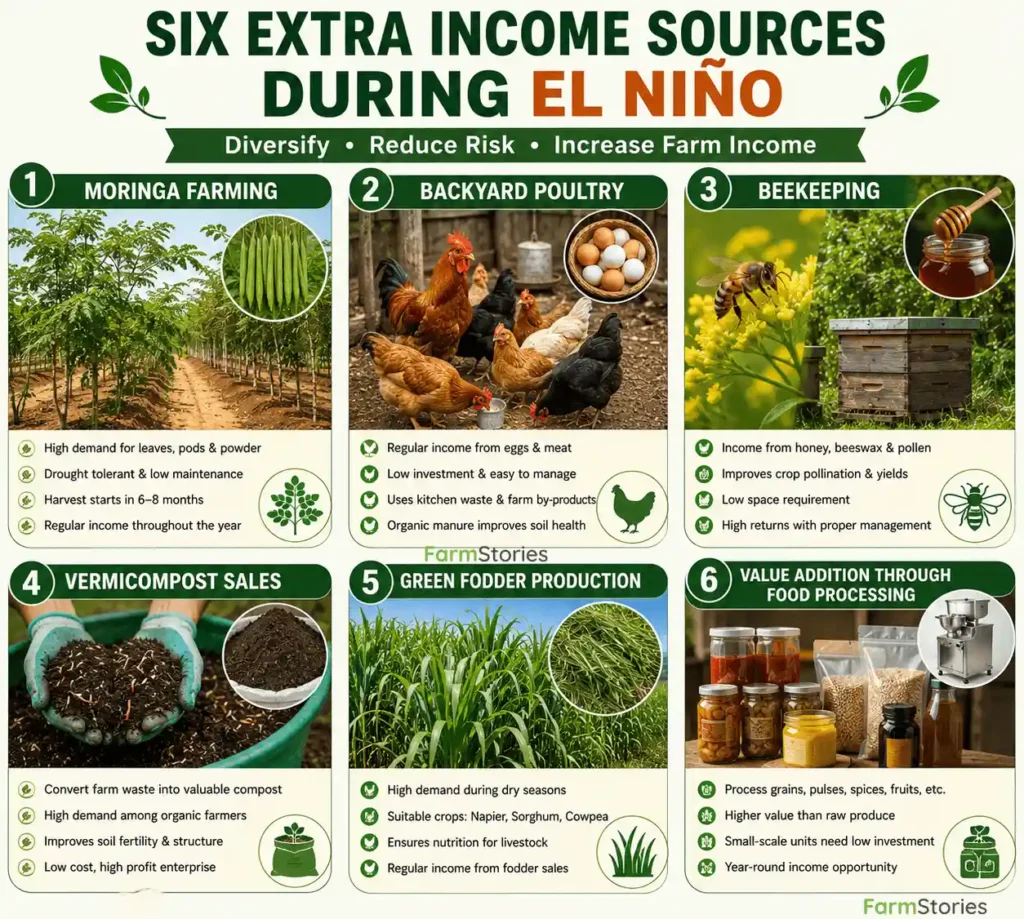
Plant Moringa Along Bunds
Moringa is well suited to dry conditions and begins producing pods within six to eight months under proper management.
Farmers can also plant perennial fodder grasses such as Napier grass between moringa trees to maximize the use of boundary space.
Benefits
Additional income from drumstick sales.
Nutritious fodder for livestock.
Better use of unused land.
Low maintenance after establishment.
Instead of becoming idle spaces, field bunds become productive assets that continue generating returns year after year.
7. Add Backyard Poultry for Regular Cash Flow
Diversifying income is one of the most effective ways to reduce financial risk.
Backyard poultry requires relatively little investment and can provide income throughout the year.
Traditional breeds such as Gramapriya, Vanaraja, Kadaknath, and Kaveri adapt well to village conditions.
They feed on insects, spilled grains, kitchen waste, and weeds found around the farm, reducing feed costs.
Income Sources
Fresh eggs
Meat
Organic manure
Many consumers are willing to pay higher prices for country chicken eggs and meat compared to commercial poultry products.
8. Convert Farm Waste into Vermicompost
Crop residues, dry leaves, weeds, and livestock manure should never be viewed as waste.
These materials can be converted into nutrient-rich vermicompost using a simple pit or vermibed.
Earthworms break down organic material into compost that improves soil fertility and water-holding capacity.
Advantages
Reduces fertilizer expenses.
Improves soil structure.
Supports beneficial microorganisms.
Recycles farm waste.
Creates another income opportunity through compost sales.
Many Farmer Producer Organisations encourage vermicompost production because it lowers input costs while improving long-term soil health.
This scheme supports protected cultivation, shade nets, polyhouses, nurseries, and horticulture development through financial assistance available under state guidelines.
Consider two farmers cultivating one acre under similar weather conditions during an El Niño year.
Conventional Farm
Climate-Smart Farm
Paddy only
Millets + pulses
Flood irrigation
Mulching + BBF planting
Chemical fertilizers
Green manure + vermicompost
Crop residue burning
Residue recycling
One income source
Crops + poultry + compost + honey
Higher production cost
Lower production cost
Greater climate risk
Better resilience
The climate-smart farmer may not always produce the highest yield from a single crop, but the farm is less dependent on one source of income. Lower production costs and diversified earnings often improve overall profitability.
El Niño Farming in India – Six Extra Income Sources
The Future of El Niño Farming in India
Weather uncertainty is becoming a regular part of Indian agriculture. Instead of waiting for favourable monsoons, many farmers are adopting practices that improve efficiency in every season.
El Niño Farming in India is not about taking advantage of drought. It is about preparing for changing weather with practical decisions that reduce risk and strengthen farm income.
Simple improvements such as green manuring, mulching, intercropping, seed treatment, vermicomposting, backyard poultry, beekeeping, and better use of field boundaries can reduce costs while making farms more resilient.
These practices do not require large investments or advanced technology. They rely on better management of resources that farmers already have.
As climate variability continues to influence Indian agriculture, farms that conserve water, improve soil health, and diversify income will be better prepared for future challenges.
Frequently Asked Questions
Is El Niño Farming in India beneficial for farmers?
El Niño itself is not beneficial because it can reduce rainfall and increase temperatures. However, El Niño Farming in India focuses on climate-smart practices that help farmers reduce costs, conserve water, and improve resilience during challenging weather conditions.
Which crops perform better during an El Niño year?
Millets, pigeonpea, green gram, black gram, cowpea, sesame, groundnut, and moringa generally perform better than water-intensive crops in areas experiencing limited rainfall.
What is the cheapest way to save water on a farm?
Mulching with crop residues, green manuring, Broad Bed Furrow planting, rainwater harvesting, and improving soil organic matter are among the most affordable water conservation methods.
Can small farmers adopt climate-smart farming?
Yes. Many practices discussed in this guide require little investment and make use of resources already available on the farm. Small changes implemented over time can significantly improve farm resilience and profitability.
Key Takeaways
El Niño increases farming risks, but good planning can reduce their impact.
Improving soil health helps crops withstand dry conditions.
Mulching and BBF planting conserve valuable soil moisture.
Intercropping reduces risk while creating an extra income source.
Farm boundaries can generate income through moringa and fodder cultivation.
Backyard poultry, vermicomposting, and beekeeping diversify farm earnings.
Government schemes can reduce the cost of adopting climate-smart technologies.
Building a resilient farm today prepares farmers for future climate challenges.
Want to see these techniques in action? Join our growing community of urban farmers by following FarmStories on LinkedIn, Instagram, YouTube, and Facebook for daily tips, video guides, and harvest inspiration!