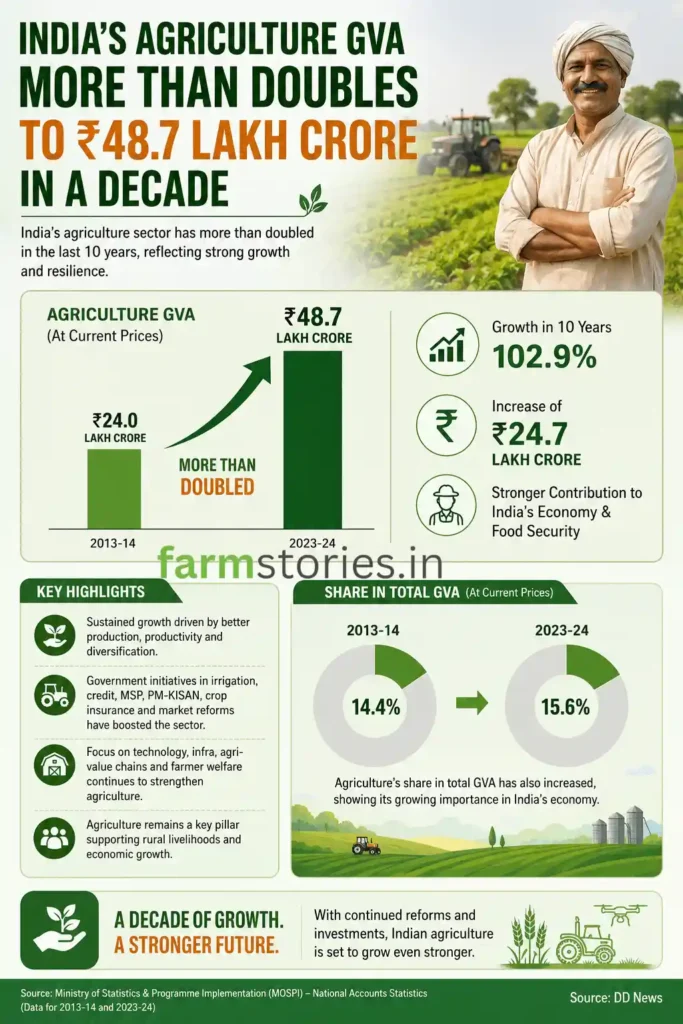
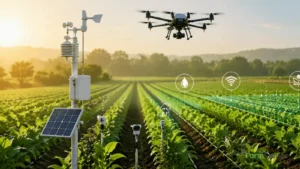
According to an official statement, the gross value added (GVA) of India’s agriculture and allied sectors experienced an unprecedented leap over the last decade. This landmark agriculture GVA growth is a direct reflection of structural interventions, policy overhauls, and the relentless resilience of the Indian farming community. The sector’s GVA more than doubled, climbing aggressively from Rs 20.9 lakh crore in fiscal year 2014-15 to an astonishing Rs 48.7 lakh crore in 2023-24. This consistent momentum of Agriculture GVA Growth confirms that farming remains a highly lucrative economic driver.
Today, this critical vertical accounts for roughly 18 percent of the country’s cumulative economic GVA, proving that despite rapid industrialization and IT growth, farming remains the absolute backbone of the Indian economic framework. Let’s look into the comprehensive data, systemic drivers, and specific commodity yields behind this monumental development.
Unpacking the Macroeconomics of Agri-GVA
When evaluating national economies, Gross Value Added offers a much more precise look into a sector’s health than raw production figures because it measures the actual value value-added to raw products before consumption. During this ten-year tracking window, the sector maintained an impressive Compound Annual Growth Rate (CAGR) of 8.83 percent at current prices.
A closer look at the data shows that crop-specific agriculture GVA growth alone expanded heavily. The independent GVA of crops scaled up from Rs 12,92,847 crore in 2014-15 to a staggering Rs 26,52,891 crore in 2023-24. This consistent upward trajectory indicates a highly diversified, market-driven, and tech-forward transition across rural ecosystems. Market experts attribute this steady rise to systemic shifts that favor long-term Agriculture GVA Growth
Core Institutional Catalysts Behind the Growth
This macro-level agriculture GVA growth did not happen in a vacuum. It is the result of a deliberate, 12-year multi-pronged government strategy focused squarely on strengthening on-field productivity, financial cushioning, institutional infrastructure, and seamless open-market pathways.
Several core operational schemes served as the foundation for this transformation:
Pradhan Mantri Krishi Sinchayee Yojana (PMKSY): This mission expanded reliable field irrigation networks, heavily moving fields away from monsoon dependency while maximizing localized water-use efficiency through micro-drip methods.
The Soil Health Card Scheme: By introducing scientific macro and micronutrient tracking, this program stopped arbitrary fertilizer spending, protecting underground soil layers while improving localized crop yields.
The Rashtriya Gokul Mission: This project elevated indigenous cattle lineages, directly boosting dairy output, smallholder financial safety nets, and livestock-based allied economy GVA.
Additionally, aggressive institutional changes—including widened agricultural credit pipelines, enhanced crop insurance penetration under PMFBY, and heavily expanded Minimum Support Price (MSP) procurement operations—gave small farm owners the market security needed to confidently scale output.
Record-Breaking Gains in Foodgrain & Horticulture Production
The physical baseline validating India’s macro agriculture GVA growth is found in the country’s record-shattering yield metrics. Driven by modern agronomics, India’s total foodgrain output surged from 265.05 million tonnes in 2013-14 to a record-setting 357.73 million tonnes in 2024-25.
Join a community dedicated to sustainable cultivation. Subscribe to FarmStories below for free, authentic insights into modern agri-tech and organic farming methods.
The Rice and Wheat Breakdowns
Rice Production: Scaled up to an all-time record of 150.18 million tonnes in 2024-25, marking a phenomenal 42 percent volume growth across the ten-year timeline.
Wheat Production: Followed a similarly strong path, climbing to 117.94 million tonnes in 2024-25, yielding a solid 36 percent total volume increase.
Simultaneously, the horticulture segment—encompassing fruits, vegetables, and aromatic crops—saw steady expansion. Total horticulture volume climbed from 280.70 million tonnes in 2013-14 to 369.05 million tonnes in 2024-25. This structural pivot toward high-value horticultural items clearly proves that Indian farmers are matching changing consumer food patterns and high-value export market demands.
For decades, the domestic market’s reliance on foreign edible oil imports put a massive strain on India’s trade balance. Correcting this was a core target over the last ten years, and the structural progress achieved has been highly impactful.
The country’s reliance on foreign oil imports fell from 63.2 percent in 2015-16 to 56.25 percent in 2023-24. This shift was achieved by scaling the national domestic oilseed cultivation area by over 18 percent. Consequently, total domestic oilseed production increased by a massive 55 percent, while individual per-hectare field productivity surged by 31 percent.
This definitive decade of agriculture GVA growth highlights a crucial transition. India’s agricultural ecosystem is moving away from traditional, survival-based farming toward a structured, technology-focused, and highly business-centric model. By integrating digital marketplaces, high-capacity food processing plants, cooperative rural models, and climate-resilient field management practices, the sector has established a solid baseline for long-term growth.
Want to see these techniques in action? Join our growing community of urban farmers by following farmstories.in on LinkedIn, Instagram, YouTube, and Facebook for daily tips, video guides, and harvest inspiration!