Every few months, a new headline announces that Google has revolutionised Indian agriculture. A farmer holds up a phone. A leaf gets scanned. AI saves the harvest. The story is neat, hopeful, and — mostly — incomplete.
The honest reality is that AI tools for Indian farmers exist on two very different planes right now. There are tools you can open on your phone today and actually use in the field. And there are powerful infrastructure projects being built in the background that will take years to reach the average smallholder. Knowing the difference matters — because not all AI tools for Indian farmers are built for the same person, or the same problem. Chasing the wrong ones wastes time and money you don’t have.
This article cuts through both the genuine progress and the noise — with a specific focus on what makes sense for farmers in Kerala and across South India.
What Google Has Actually Built (And Who It’s Really For)
Let’s start with the big news from 2024–25. Google launched two open-source AI tools that got a lot of press: the ALU API (Agricultural Landscape Understanding) and the AMED API (Agricultural Monitoring and Event Detection).
These are not apps you download. They’re backend infrastructure — a data layer that other companies and government agencies plug into.
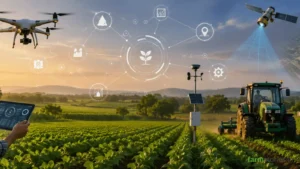
Here’s what they do. The ALU API uses satellite imagery to map individual farm boundaries across India. That’s harder than it sounds. Indian farms are small, fragmented, and packed close together. Standard global satellite maps blur them into one undifferentiated mass. ALU identifies individual plots, water bodies, and tree lines at a highly localised scale.
The AMED API goes a step further. It tells you what’s growing in any given field, when it was sown, and when it’s likely to be harvested. The data refreshes every 15 days, which means near-real-time monitoring at the field level.
Join a community dedicated to sustainable cultivation. Subscribe to FarmStories below for free, authentic insights into modern agri-tech and organic farming methods.
So who’s actually using this? Not farmers directly. Agritech startups, banks, and state governments are the real end-users. A startup called TerraStack, incubated at IIT-Bombay, has used the ALU API to build a rural land intelligence system that helps lenders assess farm credit risk without sending a field officer out. A fintech company called Sugee is using the satellite data to speed up crop loan approvals — instead of a bank waiting weeks to manually verify your land, the AI confirms your acreage and crop status automatically. The Government of Telangana is running it through an open agricultural data platform.
You might wonder — if farmers don’t use it directly, why does it matter? Because the downstream effect is real. Faster credit approvals, better-targeted subsidies, more accurate insurance payouts. These things reach you even if you never log into an API.
Google’s own research lead on agriculture has put it plainly: what’s true in Kerala may not be true in Bihar. These tools are designed to enable local, region-specific decisions. The data foundation is being laid. Applications will follow.
The AI Tool That’s Already Helping Millions: Monsoon Forecasting
Here’s something most of the press coverage missed. The most immediately impactful AI tool for Indian farmers in 2025 wasn’t an app or an advisory platform. It was weather forecasting.
Google’s NeuralGCM model — a system that combines physics-based climate modelling with machine learning trained on decades of historical data — was used by researchers at the University of Chicago to generate hyper-local monsoon onset forecasts. These forecasts were sent to 38 million Indian farmers, helping them decide exactly when to put seeds in the ground.
Think about what that means in practice. A Kerala farmer growing rice in Thrissur district gets a forecast 30 days out telling them when the monsoon is likely to actually arrive — not a broad regional guess, but a localised estimate. Studies from the same research group show that accurate advance forecasts of this kind can nearly double annual farm income, because planting at the right time changes everything: yield, input costs, and market timing.
This isn’t a pilot programme. It happened at scale. And it’s the clearest example of where AI tools for Indian farmers are delivering real, tangible value right now — not in theory, but in the ground.
What You Can Use on Your Phone Today
Beyond the backend infrastructure, the most accessible AI tools for Indian farmers are the ones already sitting on your phone — Google tools you’re probably already using, or should be.
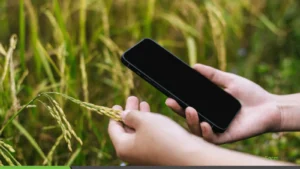
Google Lens for pest and disease checks is the most direct AI tool a farmer can pick up today. Point your phone camera at a diseased leaf and you’ll get a quick identification and possible causes. It works well for common issues — leaf spots, fungal infections, nutrient deficiencies in vegetables like tomato, chilli, and okra. A tomato grower in Maharashtra described using it as a “first check” before calling an agricultural officer — not a replacement for expert advice, but a fast filter that saves time.
The honest limitation: accuracy drops for local crop varieties, early-stage infections, and overlapping problems. If your plant has waterlogging-induced root rot combined with secondary fungal damage, the AI often gives you a broad, unhelpful answer. As with most AI tools for Indian farmers, use it as a starting point — not a final verdict.
Google Translate with voice input is underrated. Most quality agricultural content is still in English or Hindi. If you’re in Kerala and trying to understand a fertiliser label, follow a YouTube tutorial on grafting, or look up treatment options for a pest you’ve spotted — Translate bridges the gap. Use voice input rather than typing. It’s faster, especially in the field with dirty hands.
Google Maps sounds basic, but for a farmer it’s practical. Searching “drip irrigation suppliers near Malappuram” or “organic inputs Palakkad” and comparing options by rating and distance beats asking around blindly. For a new farmer setting up, this alone saves days.
Google Weather (just search your village name plus “weather”) helps with irrigation timing and spray scheduling. It’s not hyper-local enough for every microclimate in the Western Ghats, but it’s good enough for most planning decisions.
The Kerala Connection: KATHIR
Here’s something most farmers in the state still don’t know about. Among the most relevant AI tools for Indian farmers in Kerala is a government-backed platform called KATHIR, launched by the Department of Agriculture Development and Farmer Welfare.
KATHIR offers farmer registration, crop monitoring, satellite-based field health tracking, and agro-advisories — all built specifically for Kerala’s conditions. It’s described as the first of its kind in India, and it integrates advanced technology with local agricultural knowledge to support climate-resilient farming.
If you’re a farmer in Kerala and you haven’t looked into KATHIR yet, that’s worth fixing.
Where AI Tools for Indian Farmers Still Fall Short
Now for the honest part. Despite all the announcements, the reach of AI tools for Indian farmers is still very narrow. Only 20% of Indian farmers currently use any digital or AI-based tools at all. The average farmer earns roughly ₹1.25 lakh a year. And 85% are smallholders with under 1.08 hectares of land.
Against that backdrop, the promises around fully automated smart farming — sensors, IoT irrigation systems, AI-driven yield predictions — are largely out of reach. Setup costs for a proper smart irrigation system run from ₹50,000 to well above ₹5 lakh. AI yield prediction models built for large-scale monocrops don’t translate well to the mixed, small-plot farming that defines most of Kerala and much of South India.
And there’s a subtler problem. Most AI tools for Indian farmers lack the regional specificity to be genuinely useful. A model trained on Punjab wheat data doesn’t understand a Wayanad pepper plantation. This is exactly why Google’s investment in Indian-language AI and culturally grounded datasets — through its Amplify Initiative with IIT Kharagpur — matters. But that work is still in early stages.
Rural internet connectivity remains a real barrier too. Many of these tools need a stable data connection to function, and that’s still not guaranteed across India’s farming hinterland.
What Actually Works Better Than Google’s AI Tools for Indian Farmers
For most smallholders today, the most reliable sources of actionable information aren’t Google products at all. And that’s worth saying clearly.
Plantix is stronger than Google Lens for crop disease detection — it’s built specifically for Indian crops and conditions. The Kisan Suvidha app from the government covers weather, market prices, and agri-advisory in one place. ICAR advisories remain the most locally calibrated technical guidance available. And perhaps most practically, local WhatsApp farmer groups often surface real solutions faster than any of these AI tools for Indian farmers — because the person answering has grown the same crop in the same soil, in the same monsoon.
The Honest Bottom Line on AI Tools for Indian Farmers
Google is building something real. The satellite data infrastructure, the monsoon forecasting, the language models being trained on Indian dialects — this is serious work with long-term value. Some of it is already reaching farmers through apps and lending platforms they use every day, even if they don’t see Google’s name on it.
But AI tools for Indian farmers are still in an early chapter. The tools that genuinely help you today are the simple ones: search, translate, maps, weather, and Lens for a quick second opinion. The transformative stuff — real-time crop advisory, AI-driven credit, precision input recommendations — is coming through the ecosystem slowly.
The best way to use AI tools for Indian farmers right now is with clear eyes: pick what works for your specific crop, your district, and your phone. Combine them with local knowledge and extension services. And don’t let the headlines convince you that the revolution has already arrived at your field gate. It hasn’t. But it’s closer than it was last year.
Want to see these techniques in action? Join our growing community of urban farmers by following farmstories on LinkedIn, Instagram, YouTube, and Facebook for daily tips, video guides, and harvest inspiration!